Let's be honest, your IT support team is fantastic. They're the mechanics who keep your business engine running smoothly, fixing issues and handling the day-to-day grind. But who's looking at the whole race? Who's planning the pit stops and mapping the course to make sure you actually win?
That’s where a virtual CIO (vCIO) comes in.
What Is a Virtual CIO Service and Why Does It Matter?
Think of your business as a high-performance race car. Your IT support team is in the pit crew, keeping the tires fresh and the engine tuned. A vCIO, on the other hand, is the head strategist with the headset on, watching the whole track. We're not just focused on keeping things working; our goal is to make your technology work better for you—driving growth, boosting efficiency, and protecting you from risk.

A virtual CIO service closes the massive gap between reactive IT fixes and a proactive technology strategy. This strategic oversight isn't a luxury anymore; for small and midsize businesses, it's a critical part of staying competitive.
To help clarify the difference, let’s compare these two roles side-by-side.
Quick Look: Virtual CIO vs. Traditional IT Support
This table breaks down the core differences in focus and value.
| Area of Focus | Traditional IT Support (The 'Mechanic') | Virtual CIO Service (The 'Head Coach') |
|---|---|---|
| Primary Goal | Resolve immediate technical problems and maintain system uptime. | Align technology with long-term business goals for growth and profitability. |
| Time Horizon | Reactive and short-term (today, this week). | Proactive and long-term (1, 3, and 5-year planning). |
| Key Questions | "Is it broken? How do I fix it?" | "How can technology improve our bottom line? Are we secure? What's next?" |
| Value Provided | Ensures operational continuity and minimizes downtime. | Drives competitive advantage, manages risk, and maximizes ROI on tech spending. |
While both roles are essential, only the vCIO provides the executive-level guidance needed to turn your technology from an expense into a strategic asset.
The Head Coach for Your Technology
Think of us as your part-time "Technology Head Coach." Our job isn't to fix a jammed printer; it's to build a game plan that ensures every dollar you spend on technology directly supports your most important business goals.
Here’s what that looks like in practice with actionable examples:
- Strategic Planning: We don't just say "upgrade your servers." We create a detailed roadmap. Actionable Insight: For a manufacturing firm, this means planning a phased rollout of IoT sensors on the factory floor over 24 months to predict machine failures before they happen, directly reducing downtime.
- Budgeting and Forecasting: We help you build a predictable IT budget. Actionable Insight: Instead of a surprise bill for new laptops, we forecast hardware replacement costs 36 months out, turning a capital shock into a manageable operational expense.
- Risk Management: We dig into your cybersecurity and compliance. Actionable Insight: For a healthcare clinic, we'd implement encrypted email, enforce role-based access to patient records, and conduct quarterly phishing tests to meet HIPAA requirements and protect patient data.
- Competitive Advantage: We look for opportunities where tech can give you an edge. Actionable Insight: For a local retailer, we might recommend a customer loyalty app that integrates with your point-of-sale system, increasing repeat business by 15%.
For example, a property management firm might have great IT support for fixing tenant portal lockouts. A vCIO, however, would step back and identify that a new, integrated software platform could automate rent collection, maintenance requests, and vendor payments, saving the firm hundreds of hours a month. That's the strategic difference.
Making Executive-Level Strategy Accessible
For most small businesses, hiring a full-time Chief Information Officer just isn't in the cards. With an average salary easily topping $150,000 annually—not including benefits and bonuses—it's a massive expense.
This is where a vCIO service becomes a game-changer. We deliver that same executive-level strategy at a fraction of the cost, often cutting overhead by 60-70% while boosting your team's productivity. You can see a more detailed financial breakdown of why small businesses should outsource information technology services to understand the full impact.
A vCIO helps you move from constantly reacting to technology problems to intentionally using technology as a tool to build a more profitable and resilient business. It’s about making confident decisions that align your IT with your real-world priorities.
The Core Responsibilities of a Virtual CIO
A virtual CIO isn’t just another person to call when your email goes down. They step out of the daily IT grind to provide high-level, strategic direction for your entire company. Think of them as the architect of your technology future, focusing on four key areas to turn your IT from a nagging expense into a powerful business driver.
Ultimately, their job is to make sure every dollar you spend on technology directly fuels your growth, security, and bottom line. It all starts with having a clear vision.
Strategic Technology Planning
A great vCIO’s first move is to get to know your business inside and out. They need to understand where you are today and, more importantly, where you want to be in the next three to five years. From there, they build a detailed technology roadmap that lines up perfectly with your goals.
This isn't some generic shopping list for new computers. It's a strategic game plan that maps out initiatives, prepares you for growth, and stops your systems from becoming a bottleneck.
Practical Example: For a growing logistics company aiming to double its fleet in three years, a vCIO would lay out a phased roadmap:
- Year 1 (Actionable Insight): Implement a scalable, cloud-based fleet management system and GPS trackers. This provides immediate visibility and route optimization, cutting fuel costs by 10%.
- Year 2 (Actionable Insight): Integrate the fleet system with accounting software to automate invoicing and payroll, reducing administrative errors and saving 20 staff-hours per week.
- Year 3 (Actionable Insight): Deploy a business intelligence (BI) dashboard that analyzes route efficiency, driver performance, and vehicle maintenance data, providing the insights needed to make data-driven expansion decisions.
With a roadmap like this, technology becomes an enabler of growth, not an obstacle. You get a clear path forward and avoid the panicked, reactive decisions that happen when you're under pressure.
Budgeting and Financial Management
One of the biggest headaches for any small business is unpredictable IT costs. A vCIO brings discipline to your tech spending, creating stable budgets that get rid of those nasty surprises. They dig into your current expenses, pinpoint waste, and forecast the true cost of new projects.
A huge part of what a virtual CIO does is translate technical jargon into plain financial sense. This helps you make smart investments based on business value, not just the upfront price tag.
Practical Example: A law firm is considering a move to a new cloud-based document management system. The vCIO's financial forecast wouldn't just list the software license fee. It would be a complete Total Cost of Ownership (TCO) analysis.
- Actionable Insight: The vCIO's budget includes line items for:
- One-time data migration costs ($5,000).
- Productivity loss during a 2-day training period ($8,000).
- Ongoing monthly fees for advanced security and compliance add-ons ($500/month).
- Third-party integration fees to connect with the firm's billing software ($1,500).
By showing you the full financial picture, a vCIO helps the firm budget accurately, see the true ROI, and dodge the hidden costs that so often sink IT projects.
Cybersecurity and Risk Management
In 2026, protecting your business from digital threats is table stakes. A vCIO serves as your security strategist, going way beyond basic antivirus to build a complete risk management framework. They hunt down vulnerabilities, ensure you’re meeting regulatory compliance, and create solid plans to keep your business running, no matter what happens.
Practical Example: For a financial advisory firm handling sensitive client investments, a vCIO would implement a robust security strategy to meet strict SEC and FINRA regulations.
- Actionable Insight: The vCIO's plan includes concrete steps:
- Conducting a penetration test to identify and patch vulnerabilities in the network.
- Enforcing a strict data classification policy that labels documents as
Public,Internal, orConfidential. - Deploying Multi-Factor Authentication (MFA) across all applications and requiring a 90-day password rotation.
- Creating and testing a Disaster Recovery Plan that guarantees the firm can be operational within 4 hours of a major incident, a key compliance requirement.
This strategic oversight hardens your defenses, dramatically lowers the risk of a costly data breach, and builds a foundation of trust with your clients.
Vendor and Project Management
Let’s be honest—managing tech projects and haggling with vendors can be a massive time sink. A vCIO takes this off your plate completely, acting as your expert advocate and project lead. They’re the ones vetting new technology partners, handling contract negotiations, and seeing implementations through from start to finish.
Practical Example: A non-profit organization needs a new donor management CRM. The vCIO manages the entire process from start to finish.
- Actionable Insight: The vCIO’s role includes:
- Vetting: Creating a scorecard to rate five potential CRM vendors on features, cost, and integration capabilities.
- Negotiating: Using their industry knowledge to negotiate a 15% discount on the chosen vendor's annual license fee and securing a dedicated support contact.
- Managing: Holding weekly check-in meetings with the vendor and internal team to ensure the project stays on schedule and within budget, preventing scope creep and delays.
This ensures your projects get done on time, on budget, and exactly how you need them, without disrupting your core mission.
Comparing vCIO vs. MSP vs. Fractional CIO
If you’re looking into outsourced IT, you’ve probably heard a dizzying number of acronyms. vCIO, MSP, Fractional CIO… it’s easy to get them mixed up, but they all represent very different ways to handle your company's technology.
Knowing the difference isn't just about understanding the lingo. It’s about picking the right partner to help your business grow.
The Key Players in Your IT Strategy
Let's put it this way: imagine you're building a new house. Your business has a vision, a budget, and a goal. To make it a reality, you need a team with very specific jobs.
A Managed Service Provider, or MSP, is your construction crew. They are the hands-on pros who get the job done. They’re framing the walls, running the wiring, and handling all the plumbing—the day-to-day work of keeping your systems running. Their world is all about execution: resolving helpdesk tickets, monitoring your network, and stopping problems before they start.
A Fractional CIO is like a high-end architect you hire for a specific contract. They bring in top-tier expertise to design the perfect blueprint for your house. Their focus is 100% on strategy—mapping out the layout and structure to meet your big-picture goals—but they aren't the ones swinging the hammers.
A Virtual CIO (vCIO), especially one that’s part of an MSP like Cyberplex, brings it all together. The vCIO is the architect who not only designs the blueprint but is also part of the same company as the construction crew building it. This creates a seamless link between the strategic plan (the "why") and the technical team doing the work (the "how").
This guide shows how a vCIO connects planning, budgeting, security, and project management to help you make smarter strategic moves.
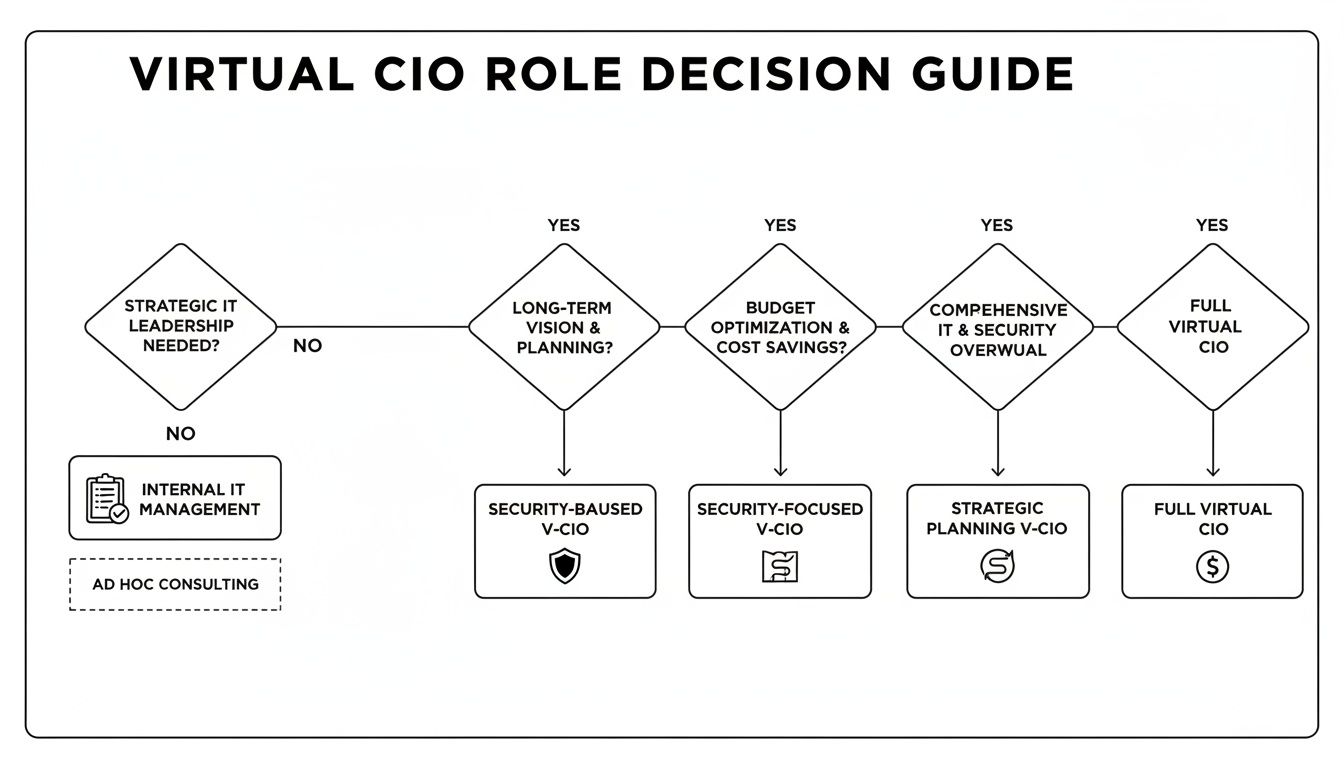
As you can see, a true vCIO service doesn't just give you a plan; it integrates that plan into every part of your technology.
A Head-to-Head Comparison
So, how do you decide which one you need? While the roles can sometimes overlap, they each have a core purpose. We put together this table to make the choice a little clearer.
Choosing Your IT Partner: vCIO vs. MSP vs. Fractional CIO
| Service Type | Primary Role | Best For Businesses Needing… |
|---|---|---|
| Managed Service Provider (MSP) | Tactical Execution & Support. Manages IT infrastructure, provides helpdesk support, and handles daily operational tasks. | Reliable day-to-day IT management, network monitoring, and responsive tech support to keep things running smoothly. |
| Virtual CIO (vCIO) | Integrated Strategy & Oversight. Aligns technology with business goals, manages budgets, and ensures the strategic vision is implemented correctly. | A cohesive blend of high-level strategy and hands-on execution, where the plan and its implementation are handled by one aligned team. |
| Fractional CIO | Pure Strategic Guidance. Provides C-level advice on technology direction, planning, and major initiatives on a part-time basis. | High-level, independent strategic advice for specific projects or board-level consulting, without an attached implementation team. |
Ultimately, the best choice comes down to what your business is missing.
When to Choose Each Service
Actionable Insight: Use this checklist to identify your primary need.
- If your biggest pain point is "My computer is slow and I can't print," you need an MSP. They solve daily technical problems. You can learn more right here about what an MSP is and how they help businesses.
- If your challenge is "We need a 5-year technology plan but our in-house IT team can handle the work," you need a Fractional CIO. They deliver pure strategy.
- If your problem is "We have daily tech issues AND no long-term plan, and we need them to work together," you need a vCIO service from an MSP. This provides both strategy and execution in one package.
For most small and midsize businesses, the most powerful setup is a virtual CIO service delivered by an MSP. This model closes the gap that often exists between an independent strategist and a separate team doing the work.
With an integrated vCIO from your MSP, there's no "lost in translation" moment. The team that helps you build the technology roadmap is the exact same team that builds, manages, and supports it every single day. This ensures every strategic goal turns into a real, measurable result for your business.
How a vCIO Drives Success for Local Businesses
Strategy is just a nice idea until it starts putting points on the board. A virtual CIO service is all about moving past high-level talk and delivering tangible wins that make your business more secure, more efficient, and more profitable.
The best way to really get it is to see it in action. Let's walk through three common scenarios where a vCIO steps in to solve real-world problems for local businesses, turning technology from a headache into a genuine advantage.

Financial Services Firm: From Anxiety to Audit-Ready
A local accounting firm was living with a constant knot in their stomach: compliance anxiety. Their client data was subject to tough regulations like GDPR and IRS security standards, and their small internal IT team was completely swamped. They had no real security strategy, leaving them wide open to ransomware and terrified of their next audit.
That’s when they brought in a virtual CIO service to get them on track.
- The Problem: No clear security roadmap, inconsistent policies, and a very real risk of failing a compliance audit.
- The vCIO's Solution: First, the vCIO performed a deep-dive risk assessment, rooting out every potential vulnerability. From there, they built a multi-layered security plan. Actionable Insight: The plan included mandatory multi-factor authentication on all financial software, deploying endpoint detection and response (EDR) to monitor for threats in real-time, and running quarterly phishing simulation campaigns to train employees.
- The Bottom-Line Impact: The firm sailed through its next audit with confidence. The vCIO's plan didn't just protect sensitive client data; it created a documented, repeatable security process. This turned compliance from a yearly fire drill into a manageable routine—a crucial shift when 43% of all cyberattacks target smaller businesses that often lack this kind of strategic oversight.
Property Management Company: Streamlining the Chaos
A property management company with buildings dotted across Henderson, NC, and the surrounding counties was drowning in operational chaos. Communication between the main office and on-site managers was a mess of personal cell phones and tangled email chains. Their ancient server-based software just couldn't keep up.
Their vCIO stepped in to map out a path forward.
- The Problem: Disconnected systems, poor communication, and manual processes that were eating up hundreds of hours every month.
- The vCIO's Solution: The vCIO laid out a two-year plan focused on moving to the cloud. Actionable Insight: Phase one involved migrating to Microsoft 365 and setting up dedicated Microsoft Teams channels for each property to streamline communication. Phase two involved managing the selection and implementation of a cloud-based property management platform that integrated maintenance tickets, rent payments, and vendor management.
- The Bottom-Line Impact: The company completely streamlined its operations, cutting administrative overhead by an estimated 25%. Staff could finally collaborate in real-time from anywhere, and managers got a single dashboard to see the entire portfolio at a glance. It's a perfect example of how vCIO guidance is shown to reduce deployment risks by 35% for major projects like a move to the cloud.
Public Sector Agency: Optimizing a Tight Budget
A local public sector agency was stuck between a rock and a hard place. Their IT infrastructure was creaking with age, but their budget was ironclad, with zero room for surprises. They desperately needed a long-term plan to upgrade their systems without disrupting critical public services.
A vCIO provided the strategic and financial foresight they were missing.
A vCIO's value in the public sector comes from translating technical needs into a clear, justifiable budget request. They help leaders make data-driven decisions that balance fiscal responsibility with operational necessity.
- The Problem: Outdated technology, a restrictive budget, and absolutely no plan for future infrastructure upgrades.
- The vCIO's Solution: The vCIO audited every piece of their existing technology and mapped out a five-year replacement lifecycle. Actionable Insight: The plan prioritized replacing the core network switches in Year 1 (to support emergency services communications) and scheduled the server fleet for replacement in Year 3. By forecasting these costs precisely, the vCIO created a budget request that was approved because it eliminated future emergency spending.
- The Bottom-Line Impact: The agency dodged catastrophic hardware failures and successfully secured the funding for systematic, planned upgrades. This strategic planning ensured essential public services continued without interruption and got rid of the risk of expensive, last-minute emergency replacements. It's this exact ability to provide clarity that explains why the vCIO market is projected to grow by 19.4% CAGR through 2030.
Understanding vCIO Pricing and Calculating Your ROI
Let's talk numbers. It's easy to get hung up on the cost of a virtual CIO service, but the real conversation we should be having is about the return it brings back to your business. Moving past the price tag to see the long-term value is how you make a smart investment, not just another purchase.
Outsourcing high-level IT strategy is exploding in popularity, and for good reason. The virtual CIO (vCIO) services market was valued at $30 billion in 2024, which was a massive 20% jump from the year before. With projections showing the market will likely hit $45 billion by 2029, it's obvious that small and mid-sized businesses are catching on to this affordable way to get top-tier strategic planning. You can explore the full virtual CIO services market analysis if you want to dig deeper into the trend.
Common vCIO Pricing Models
So, what does it actually cost? Well, vCIO pricing isn't a one-size-fits-all deal. It’s built to be flexible, scaling to match exactly what your business needs. Most providers, including us, typically use one of three models:
- Fixed Monthly Retainer: This is the go-to for most businesses. You get ongoing strategic guidance for a predictable monthly fee. It’s perfect if you need continuous IT leadership, help with budgeting, and a solid technology roadmap.
- Project-Based Fees: Have a specific, one-time initiative? Maybe you're migrating to a new software platform, managing an office move, or finally building that disaster recovery plan. You can hire a vCIO for a single project with a clearly defined scope and cost.
- Bundled with Managed Services: This is where the magic really happens. Many Managed Service Providers (MSPs) like Cyberplex roll vCIO services into a complete managed IT package. This is a powerful setup because it puts the team creating your strategy in direct communication with the team that's actually implementing it.
Shifting from Cost to Investment: Calculating Your ROI
Here’s the thing: thinking of a vCIO as just another "cost" is a big mistake. A good vCIO is an investment that should pay for itself, often many times over. The question shouldn't be "What does it cost?" but "What's my return on this investment?"
Figuring out the ROI for a vCIO involves looking at both the hard numbers—direct cost savings—and the softer value you get from reducing risks and making your team more productive. You can start to put a real number on it by looking at a few key areas.
A vCIO doesn't just manage your technology; they unlock its potential to grow your bottom line. Their value is measured in mitigated risks, optimized spending, and new efficiencies that fuel your business.
Let’s look at a practical example of how the numbers stack up.
Example ROI Calculation for a 30-Employee Firm
Here's a quick, hypothetical breakdown for a small business. Actionable Insight: Use this template with your own numbers to estimate your potential ROI.
| Value Driver | Annual Savings / Value | Explanation |
|---|---|---|
| CIO Salary Savings | +$130,000 | You get C-suite strategy without the $150,000+ annual salary of a full-time, in-house CIO. |
| Productivity Gains | +$45,000 | Even a 5% productivity boost from better systems and fewer tech headaches adds up fast across 30 employees. |
| Smarter Vendor Deals | +$12,000 | A vCIO negotiates better deals on software licenses and internet contracts, saving you $1,000/month. |
| Prevented Data Breach | +$100,000 | You avoid the astronomical costs of a breach (forensics, fines, reputation damage) with a proactive security strategy. |
| vCIO Service Cost | -$36,000 | You invest in a vCIO retainer at $3,000/month. |
| Estimated Annual ROI | +$251,000 | The net gain here shows just how powerful the return on this investment can be. |
Even using conservative numbers, the financial argument is incredibly strong. By preventing just one major incident or unlocking small productivity gains, a vCIO service proves its value almost immediately. It’s how you turn technology from a reactive expense into a proactive engine for growth.
How to Choose the Right Virtual CIO Partner
Picking a virtual CIO isn't like hiring just any consultant. You’re choosing a strategic partner who will have a real hand in shaping your company's future. To find that perfect fit, you've got to cut through the sales pitch and ask the hard questions.
A true partner will have solid, confident answers that show they can think big picture but also get their hands dirty. This whole process is about making sure they can actually deliver. A great way to start is to organize your questions into three critical areas.
Evaluate Their Industry Experience
A vCIO who already gets your industry’s unique challenges can hit the ground running. They’ll be familiar with the compliance headaches, operational snags, and competitive pressures you deal with every single day.
Actionable Insight: Use these questions to see if they have relevant experience:
- "Can you share a specific example of how you guided a company in the [Your Industry] sector through a major technology change?"
- "What compliance frameworks (like HIPAA, CMMC, or FINRA) are you most experienced with, and how have you helped clients achieve and maintain compliance?"
- "Based on your experience with businesses like mine, what is the single most common and costly technology mistake you see, and what's your first step to fix it?"
You’re listening for specific stories, not vague, generic answers. If they can tell you about solving a real problem for a business just like yours, that’s a huge plus.
Scrutinize Their Strategic Process
Strategy without a clear process is just a bunch of wishful thinking. A great vCIO partner should be able to walk you through exactly how they create and execute a technology roadmap.
A provider's process reveals their true value. If they can’t show you a blueprint, they can’t be trusted to build the house. Don't settle for vague promises; demand to see the framework they use to deliver results.
Actionable Insight: Ask them to show you, not just tell you:
- "Could you show me a sanitized example of a technology roadmap and a quarterly business review (QBR) deck you've prepared for a client?"
- "How do you define and track key performance indicators (KPIs) to measure the success of your strategy? Can I see an example dashboard?"
- "Walk me through your process for conducting a technology assessment. What specific deliverables, like a risk register or budget forecast, would we receive?"
The goal here is simple: you want to see proof of a structured, repeatable system for turning your business goals into a real, actionable IT plan.
Confirm Their Service Integration
The biggest point of failure we see is the disconnect between strategy and execution. A vCIO can come up with a brilliant plan, but it means nothing if the IT support team can't—or won't—implement it. This is especially true if you’re getting a virtual CIO service from a managed service provider.
For a deeper look at vetting providers, our guide on how to choose a managed service provider has a ton of other valuable questions to ask.
Actionable Insight: Use these questions to check for a seamless connection:
- "How does the strategic roadmap you build get translated into actionable tickets for the helpdesk team?"
- "What communication protocols are in place between the vCIO and the technicians handling our daily support? Do they meet regularly?"
- "Describe a time a strategic project faced an unexpected technical hurdle. How did your vCIO and technical teams work together to resolve it?"
A strong partner will have a clear, established system to ensure the architect (the vCIO) and the build crew (the IT support team) are always working from the same blueprints. This alignment is the secret to turning great ideas into real business success.
Answering Your vCIO Questions
Okay, so you get the big picture of what a virtual CIO can do. But what does it actually look like day-to-day for your business? We get a lot of questions about the practical details, so let's clear up some of the most common ones.
How Much Time Will a vCIO Actually Spend on My Business?
This is a big one. Business owners often worry if a "part-time" strategist can really give their company the attention it deserves. The short answer is yes, because a virtual CIO service isn't about clocking in and out; it's about delivering specific outcomes.
Practical Example: In the first 30-60 days (the discovery phase), a vCIO might spend 15-20 hours learning your business, interviewing key staff, and conducting a full technology assessment. After that, it typically shifts to a regular cadence, such as:
- A 2-hour monthly strategy meeting.
- A 4-hour quarterly business review (QBR) to track progress.
- 4-6 hours per month for ongoing budget management, vendor calls, and project oversight.
This dedicated time is focused purely on high-value strategic work, not fixing printers.
Can I Hire a vCIO for Just a Single Project?
Absolutely. While ongoing strategy is where a vCIO provides incredible long-term value, you can definitely bring one in for a specific, one-time project. It's the perfect solution when you're facing a complex challenge your in-house team just doesn't have the experience to handle.
Actionable Insight: This project-based approach works incredibly well for initiatives with a clear start and end, such as:
- Office Move: Planning and overseeing the entire IT relocation, from internet circuits to network setup, ensuring zero downtime on move-in day.
- Software Migration: Managing a full migration to a new ERP or CRM, including vendor selection, data mapping, and user training.
- Cybersecurity Overhaul: Leading a project to achieve a specific certification, like CMMC or SOC 2, by a set deadline.
This gives you access to executive-level expertise precisely when you need it, without a long-term commitment.
What’s the First Step to Get Started?
Getting the ball rolling is simple. It all starts with a no-obligation chat where we can talk about your business goals and your current tech headaches. This isn't a sales pitch; it's a real conversation to see where you're feeling stuck.
Actionable Insight: In this initial 30-minute call, our goal is to understand three things:
- Where is your business headed in the next 1-3 years?
- What is the biggest technology-related obstacle holding you back right now?
- What would a "win" look like for you in terms of IT?
This first meeting is your chance to ask us anything and our chance to start mapping out a path that could make a real difference for your company.
Ready to align your technology with your business goals? The team at Cyberplex Technologies LLC offers a no-obligation consultation to assess your strategic IT needs and show you how a virtual CIO can drive real results. Learn more about our approach at https://www.cyberplextech.com.