Think of a managed firewall service as hiring a dedicated, 24/7 network security team for your business. Instead of just getting a piece of hardware or software and being left to figure it out, a managed service provider actively handles the monitoring, management, and updates for you. You get enterprise-grade protection without the enterprise-grade headache and overhead.
So, What Exactly Is a Managed Firewall Service?
Let’s use an analogy. Imagine your business network is a high-security building. A standard, unmanaged firewall is like buying a really strong, complex lock for the front door and installing it yourself. It’s a great first step, for sure. But now you’re the one responsible for checking every single person who tries to get in, vetting their credentials, and dealing with it if someone tries to kick the door down. The entire security burden falls squarely on your shoulders.
A managed firewall service, on the other hand, is like hiring a professional security firm to guard that building around the clock. They don't just sell you the lock; they install it, manage the keys, monitor all the entrances, and handle any incidents immediately.
This all-in-one approach combines three critical pieces into a single, cohesive service:
- Top-Tier Firewall Technology: This is the actual hardware or cloud-based software that stands as the guard wall between your private business network and the public internet.
- An Expert Security Team: You get immediate access to certified professionals who live and breathe threat management, policy configuration, and incident response. They’ve seen it all.
- Proactive, Hands-On Management: This is the secret sauce. It’s the continuous, day-in-day-out work of monitoring traffic, patching vulnerabilities, updating threat lists, and reporting back to you on how secure your network truly is.
Shifting from a DIY Headache to Expert Oversight
For most small and mid-sized businesses, the difference between a DIY setup and a managed service is night and day. A DIY approach often forces your internal IT team—who are likely already juggling a dozen other priorities—to suddenly become cybersecurity experts. They're on the hook for everything from the initial, complicated setup to responding to every single security alert. It can quickly become a full-time job they simply don't have time for.
Practical Insight: If your IT person spends hours each week reviewing firewall logs or researching how to block a new threat, that's time they aren't spending on projects that drive business growth, like improving your e-commerce platform or streamlining internal workflows.
A managed firewall service shifts the operational burden from your internal team to a dedicated provider. This allows you to focus on your core business activities while security experts ensure your first line of defense is always robust and up-to-date.
Understanding the practical differences is key. This table lays out exactly what changes when you move from a DIY approach to a professionally managed one.
Managed Firewall Service at a Glance
| Component | Unmanaged Firewall (DIY Approach) | Managed Firewall Service (Expert Approach) |
|---|---|---|
| Initial Setup | Handled internally; requires deep, specialized knowledge of network architecture and security policies. Example: Your team spends 40+ hours configuring ports and rules, with a high risk of misconfiguration. | Performed by certified experts who configure the firewall based on your specific business needs and risks. Example: Provider analyzes your business apps and creates custom rules in a fraction of the time. |
| Policy Updates | Your team must manually create and update access rules, often only after a new threat appears. Example: A new phishing scam emerges; your team must research it and manually block the malicious IP addresses. | Proactively managed by the provider, ensuring rules are always optimized and aligned with current best practices. Example: Provider's threat intelligence network automatically blocks the new phishing IPs across all client firewalls instantly. |
| Threat Monitoring | Relies on internal staff to check logs and handle alerts, which usually only happens during business hours. Example: An automated attack begins at 2 AM on a Saturday; it goes unnoticed until Monday morning. | Includes 24/7/365 monitoring by a Security Operations Center (SOC) to detect and shut down threats instantly. Example: The 2 AM attack is detected and blocked within minutes, with an alert sent to the SOC analyst for verification. |
| Maintenance | Entirely your responsibility, including firmware updates, patching security holes, and hardware replacement. Example: A critical vulnerability is announced; your team must schedule downtime to apply the patch. | All hardware and software maintenance, from patching to full upgrades, is handled by the provider. Example: The provider applies the critical patch overnight during a pre-approved maintenance window with zero disruption to you. |
As you can see, the expert approach isn't just about offloading tasks—it's about gaining a higher level of security and expertise that's nearly impossible to replicate in-house without a significant investment in time, training, and talent.
Key Benefits for Small and Medium Businesses

For a small or medium-sized business, a managed firewall service is about much more than just "better security." It's about regaining your focus, creating financial predictability, and building a more resilient operation. You get to move from constantly reacting to problems to having a proactive security partner in your corner.
This shift frees up your team. Instead of grappling with complex IT security tasks they weren't hired for, your key people can get back to what they do best—generating revenue and serving your clients. No more troubleshooting cryptic network alerts or spending hours researching the latest threats.
From Unpredictable Costs to a Stable Investment
One of the biggest wins for any SMB is turning a volatile, unpredictable capital expense into a stable, manageable operating expense. The true cost of an unmanaged firewall is full of expensive surprises.
Think about it:
- Emergency Repairs: What’s the plan when your firewall hardware dies on a Saturday night? Emergency call-outs and rush replacements can blow your budget in an instant.
- Hiring and Training: A single cybersecurity expert demands a hefty salary. Add in the constant cost of training and certifications for ever-changing tech, and the numbers climb fast.
- Downtime: A simple misconfiguration or a single breach can bring your entire business to a halt. The lost revenue and damage to your reputation will always cost more than the hardware itself.
A managed firewall service wraps all these potential bombshells into one predictable monthly fee. Budgeting becomes straightforward, and you're protected from the financial shocks that can derail a growing business. It’s no wonder the market is expected to grow from $4 billion to a projected $10 billion by 2030.
Turning Security into a Business Enabler
Beyond just saving money, a properly managed firewall becomes a powerful tool that helps you win and keep business. It ensures you meet compliance standards and proves you can protect sensitive information, turning security from a cost center into a genuine asset.
For many local businesses, this is the cornerstone of their entire security strategy, often as part of a larger cybersecurity as a service model.
By outsourcing firewall management, you're not just buying a service; you are acquiring peace of mind and demonstrating a commitment to security that clients and partners can trust.
This has a direct impact right here in our community.
Actionable Example for a Financial Firm: An accounting firm in Henderson absolutely must comply with strict regulations for protecting client financial data. A managed firewall provides the expert-level security policies and detailed audit logs needed to prove compliance and avoid massive fines. This includes setting up specific rules to block traffic from high-risk countries and generating monthly reports that can be used during an audit.
Actionable Example for a Legal Office: A local law practice handles incredibly sensitive and confidential case files. The managed firewall ensures this data is locked down with advanced threat prevention, protecting attorney-client privilege and upholding the firm’s trusted reputation. For instance, the service can create a secure, encrypted VPN for attorneys to access files remotely, with all activity logged and monitored for unauthorized access attempts.
How a Managed Firewall Actually Protects Your Business
It's one thing to talk about what a firewall does, but it’s another to see the difference it makes in a real-world crisis. Let's walk through a common scenario: a sneaky ransomware attack hitting two different businesses. One has a basic, off-the-shelf firewall. The other has a managed firewall service. The difference is night and day.
In the first business, an employee clicks a bad link in an email. The malware slips past their simple firewall and starts quietly locking up files. Since nobody is actively watching the network around the clock, the attack goes completely unnoticed. The first sign of trouble is the ransom note that pops up, bringing the entire operation to a screeching halt.
Now, let's look at the business with a managed firewall. The story plays out very differently.
From Day One to Active Defense
Our work begins long before any attack is launched. We start with a deep dive into your business—how you work, where your critical data lives, and what your specific risks look like. This isn't about just plugging in a box; it's about building a defense strategy that fits your company.
From there, we put a series of practical protections in place:
- Custom Firewall Rules: We configure the firewall to match your exact business needs, essentially creating a "block everything by default" policy and only allowing pre-approved, necessary traffic. Actionable Insight: For a marketing agency, this means allowing access to social media platforms while blocking file-sharing sites known for distributing malware.
- 24/7 Expert Monitoring: Our Security Operations Center (SOC) team keeps a constant watch over your network traffic. They use sophisticated tools to spot suspicious activity that would be completely invisible to an untrained eye. Practical Example: An employee's computer suddenly starts sending large amounts of data to an unknown server in another country. The SOC team sees this abnormal behavior and investigates immediately.
- Instant Threat Shutdown: When that same malicious link gets clicked, our firewall spots the malware trying to phone home to its command server. Our SOC team is immediately alerted, the connection is severed on the spot, and the infected computer is quarantined from the rest of the network.
For the business owner, it’s a non-event. They get a simple report from us explaining the attempted attack and how we stopped it. The outcome? Zero downtime, zero data loss, and zero panic.
A managed firewall turns cybersecurity from a reactive scramble into a proactive shield. It’s the difference between cleaning up a disaster and stopping it before it ever starts.
How This Looks for Henderson Businesses
This level of round-the-clock defense is a game-changer for organizations right here in Henderson. Having experts actively managing your security is what keeps your doors open and your data safe. For a deeper look at the fundamentals, check out our guide on network security for small businesses in our detailed guide.
Example 1: A Local Property Management Company
Think about a property manager with offices spread across different sites. They're handling a mountain of sensitive tenant data, from financial records to personal information. A managed firewall secures the links between every location, protecting that data whether it's sitting on a server or being sent between offices. Actionable Insight: The service sets up a site-to-site VPN, creating a secure, encrypted tunnel for all communication between the main office and satellite locations, preventing eavesdropping on public internet lines. This keeps them compliant and, more importantly, keeps their tenants' trust.
Example 2: A Public Safety Agency
For a local first-responder agency, network failure is simply not an option. Dispatch systems, records, and communications have to stay online 24/7. A managed firewall provides the heavy-duty protection needed to fend off denial-of-service (DoS) attacks or other cyber threats that could take critical community services offline. Actionable Insight: The provider configures the firewall with DoS mitigation that can absorb and deflect a flood of malicious traffic, ensuring that legitimate dispatch calls and data requests are never interrupted. It ensures our first responders always have the life-saving tools they depend on.
Comparing In-House vs Managed Firewall Services
So, you know you need a firewall. The real question is, who’s going to manage it? This is a bigger decision than most business owners realize, and it’s not just about buying a box and plugging it in. You’re essentially choosing between building your own security team from scratch or bringing in a team of dedicated experts.
Going it alone means your team is on the hook for everything. We're talking about the initial hardware cost, sure, but also the endless cycle of training, certifications, and software updates. And what happens when a new threat pops up at 2 AM? That burden falls squarely on your staff, which is a fast track to employee burnout and, worse, a slow response when every second counts.
A managed firewall service completely changes the game. Instead of relying on one or two internal IT people who have to be experts in everything, you get an entire team of security specialists on your side. For us, this is all we do. We live and breathe this stuff, tracking the latest threats so your defenses are never out of date.
In-House vs Managed Firewall: A Head-to-Head Comparison
To really see the difference, you have to look past the upfront price and consider the day-to-day realities. We’ve put together this table to break down what each path truly involves.
| Factor | In-House Firewall Management | Managed Firewall Service |
|---|---|---|
| Total Cost | High and unpredictable; includes hardware, salaries, training, licensing, and emergency support. | Predictable monthly fee; covers all expertise, technology, and 24/7 support. |
| Expertise | Limited to the knowledge of your internal staff, which requires constant, expensive training. | Access to a deep bench of certified security specialists with broad industry experience. |
| Threat Response | Often delayed; response is dependent on your team's availability and working hours. | Immediate 24/7 response from a Security Operations Center (SOC) that stops threats in real-time. |
| Scalability | Difficult and expensive; requires purchasing new hardware and licenses to accommodate growth. | Flexible and seamless; services scale up or down with your business needs without large capital costs. |
| Compliance | Burdensome; your team is responsible for generating reports and proving compliance. | Simplified; provider generates detailed reports needed for audits and regulatory requirements. |
When you look at it this way, the choice becomes much clearer. You're not just buying a service; you're buying a result: security that just works.
Think of it like this: when a threat is detected, you come to a fork in the road.
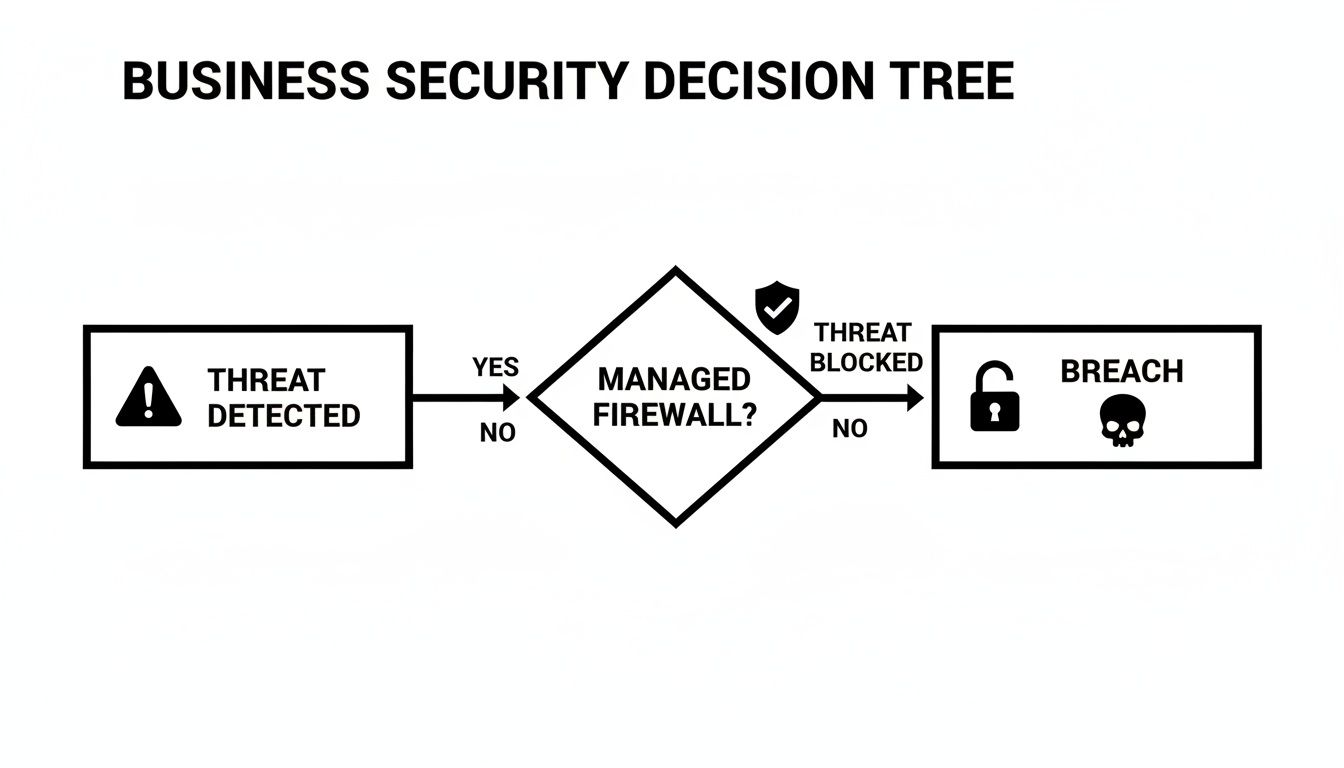
One path—the managed path—is a clear checkpoint where threats are stopped cold. The other path can often lead straight to a security breach if your internal team is overwhelmed or simply not available.
Making the Smart Financial Decision
At the end of the day, it comes down to your total cost of ownership (TCO) and how much risk you're willing to accept. The DIY approach might look cheaper on paper initially, but the hidden costs of staffing, ongoing training, and the massive financial hit from a potential breach can be devastating. The numbers don't lie: 60% of small businesses that suffer a cyberattack go out of business within six months.
Actionable Insight: To calculate your potential TCO for a DIY approach, add up the firewall hardware cost, annual software/license fees, the salary of an IT employee (or fraction of their time), annual training costs, and an estimated cost for emergency support. Compare this total to the flat monthly fee from a managed provider. The managed option is often lower and always more predictable.
For most small and mid-sized businesses, a managed firewall service is simply the more financially sound and secure path forward. It turns a chaotic, unpredictable capital expense into a stable, manageable operating cost, all while giving you access to expertise you couldn't afford to hire full-time.
For any growing business here in Henderson, this is about more than just saving a few dollars. It’s about building a resilient company that can weather any storm. When you let experts handle your security, you free up your own team to focus on what they do best—driving your business forward. You can rest easy knowing your digital front door is being watched around the clock. That makes it one of the smartest strategic investments you can make in your company’s future.
How to Choose the Right Managed Firewall Provider

Picking a provider for your managed firewall service is a big deal. It’s about much more than just the technology. You’re not just buying a service; you're bringing a security partner into your business—an extension of your team that will guard your most valuable digital assets.
To find a true partner and cut through all the sales noise, you need a solid game plan. This starts with asking the right questions, the kind that show you what a provider is really made of. Let's walk through how to evaluate them on the things that actually matter to your company's security and daily operations.
The market for these services is blowing up. It’s projected to jump from USD 31,634.91 million in 2025 to an incredible USD 89,777.03 million by 2033. That growth means a lot of new companies are entering the field, making it more important than ever to have a clear process for choosing the right one.
The Essential Vendor Checklist
When you sit down with a potential provider, have this checklist ready. Their answers will tell you everything you need to know about their expertise, how they operate, and if you can count on them. Don't be shy about asking for specifics.
- What are your specific Service Level Agreements (SLAs) for threat response? You need clear, guaranteed response times. Will they jump on a critical alert in 15 minutes? An hour? The SLA is your promise that they’ll act fast when it counts. Actionable Insight: Ask for their SLA matrix. It should clearly define what constitutes a "critical," "high," or "medium" priority event and the guaranteed response time for each.
- What certifications does your security team hold? Look for well-known credentials like CompTIA Security+, Certified Ethical Hacker (CEH), or certifications for the specific firewall brands they use. This is proof that their team has been formally trained and tested on modern security. Actionable Insight: Ask if you can speak to one of their senior security engineers during the sales process to gauge their expertise directly.
- How will your service scale as my business grows? A great partner won't force you into a huge hardware replacement just because you're expanding. They should have a clear path to grow with you, whether that means adding capacity or protecting new offices and remote workers. Actionable Insight: Ask them: "If we acquire another small company next year, what is the exact process and cost to bring their network under your protection?"
Digging Deeper Into Their Process
Beyond that first round of questions, you need to understand how they'll actually work with your business. It's not just about their tech skills; it's about finding a team that fits your company culture and goals.
A provider's reporting and communication process is a direct reflection of their transparency. If their reports are confusing or infrequent, you'll be left in the dark about your own security status.
Ask them for a sample security report. Can you actually read and understand it, or is it just a bunch of technical data? A quality partner gives you clean, simple reports that summarize blocked threats, network health, and what you can do to improve. For more on this, our guide on how to choose a managed service provider is a great resource.
Finally, ask for case studies or references, especially from businesses like yours. If you're a local accounting firm or medical practice in the Henderson area, a provider who already protects similar clients knows the specific compliance and data security challenges you're up against. That kind of specialized experience is gold.
Frequently Asked Questions About Managed Firewalls
When you're looking at a managed firewall service, a few questions always come up. These are the practical, bottom-line concerns you need answers to before making a decision. Let's get straight to it and clear up the most common questions we hear from business owners.
How Much Does a Managed Firewall Service Cost?
This is always the first question, and understandably so. The cost comes down to a predictable monthly fee. The exact amount will depend on your company’s size, how complex your network is, and the specific level of protection you need, but the key takeaway is predictability. You’re swapping surprise IT expenses for a stable, budgeted line item.
Let's put that into perspective. Hiring just one qualified cybersecurity specialist can easily run you over $100,000 per year once you factor in salary, benefits, and training. Then you still have to buy the hardware and software licenses. The monthly fee for a managed service is a fraction of that.
But the most critical comparison isn't against an IT salary—it's against the cost of a data breach. For a small business, a single security incident can spiral into six-figure losses and do permanent damage to your reputation. A manageable monthly fee is a small price for that kind of peace of mind.
Will a Managed Firewall Slow Down Our Internet?
It’s a common fear: will adding more security create a bottleneck that frustrates your team? It's a valid concern, but in reality, the opposite is usually true. A professionally configured firewall, managed by experts, is optimized for performance and won't cause any noticeable lag.
An expert provider does more than just block threats; they actively manage your network's bandwidth to make sure everything runs smoothly. Here's how:
- Performance Optimization: We make sure the firewall hardware is perfectly sized for your internet connection and the number of people using it, so it never becomes a chokepoint.
- Traffic Shaping: We can prioritize what matters most. Critical business tools, like your cloud-based CRM or VoIP phone system, get the bandwidth they need before less important traffic. Practical Example: During a video conference call with a major client, the firewall ensures the call quality remains crystal clear by giving it priority over a large file download happening in another department.
- Proactive Maintenance: Our team is constantly monitoring and updating the system. This prevents the slowdowns that happen when equipment is left to get old and outdated.
In many cases, businesses actually tell us their network feels faster once we’re on board, simply because the traffic is being handled so much more efficiently.
Is My Business Too Small for This Service?
This might be the most important question of all. A lot of small business owners think they’re not a target for cybercriminals, but the data tells a different story. Attackers often go after smaller companies because they know security is likely to be weaker.
A managed firewall service scales to fit any business size, making it an affordable and absolutely essential tool. It gives you access to the same kind of powerful security technology and expertise that large corporations use—the kind that would be impossible to get on your own.
Practical Example: A five-person real estate agency handles client social security numbers and bank details. While small, a breach would be catastrophic. A managed firewall provides affordable enterprise-grade protection, securing their data and reputation for a predictable monthly cost, allowing them to compete with larger, more established firms.
Don't think of it as a big-company luxury. Think of it as leveling the playing field. For a small law firm in Henderson protecting confidential client records or a local financial advisor safeguarding sensitive data, this service is a core part of running a secure, responsible business. It’s how you protect everything you’ve worked so hard to build.
Ready to secure your network without the headache? Cyberplex Technologies LLC delivers expert, proactive managed firewall services to protect your Henderson business 24/7. Discover how we can customize a solution for you.