Managed IT services offer small businesses a way to get top-tier technology and security expertise, all for a predictable monthly fee. It’s about turning your IT from a constant, frustrating expense into a real asset that helps you grow.
Why Smart Small Businesses Outsource Their IT Support
Imagine you own a bustling local shop here in Henderson, and your point-of-sale system crashes on a busy Saturday. You wouldn't just start tinkering with wires and code while customers are waiting, right? You'd call an expert, immediately.
Your business's technology is no different. When your network goes down or a server gives up, the chaos that follows costs you time, money, and—most importantly—your customers' trust.
This is exactly why so many smart small businesses are changing their approach. They're ditching the old "break-fix" method, where you only call for help when something is already broken. Instead, they’re forming a proactive partnership with a Managed Service Provider (MSP). An MSP doesn't just put out fires; our main job is to stop them from ever starting.
Actionable Insight: Instead of waiting for a system to fail, take inventory of your critical technology. List your servers, key computers, and network equipment. Note their age. If any key component is over 5 years old, it's a potential failure point. An MSP can use this list to create a proactive replacement plan, preventing an emergency before it happens.
From Reactive Chaos to Proactive Strategy
For a lot of small business owners, IT is a huge source of anxiety. You're facing the same sophisticated security threats and compliance rules as the big corporations, but with a tiny fraction of their budget. Hiring a full-time, in-house IT expert is often out of the question, and making a "tech-savvy" employee your go-to person is just asking for trouble.
Managed IT services for small businesses is the perfect solution to this problem. Instead of shelling out for expensive emergency repairs, you pay a flat, predictable monthly fee for a whole team of specialists who actively manage, monitor, and secure your entire tech setup.
This proactive model is quickly becoming the new standard. The global managed services market is expected to skyrocket, growing at 13.6% annually through 2030. What's driving this? Small and mid-sized businesses that are cutting IT costs by up to 45% and boosting their operational efficiency by over 60%.
By outsourcing your IT management, you aren't giving up control—you're gaining a strategic partner. You can learn more about the specific benefits in our detailed guide on why small businesses should outsource their IT services. It frees you up to stop worrying about technology and get back to what you do best: running and growing your business.
What Do You Actually Get with Managed IT Services?
So, what does partnering with a Managed Service Provider (MSP) really look like day-to-day? Let’s be clear: this isn’t just about having someone to call when a printer jams or a password gets lost. True managed IT is a completely different approach, built on a few core pillars that keep your business secure, efficient, and ready for whatever comes next.
Think of these services as the foundation of your entire technology strategy.
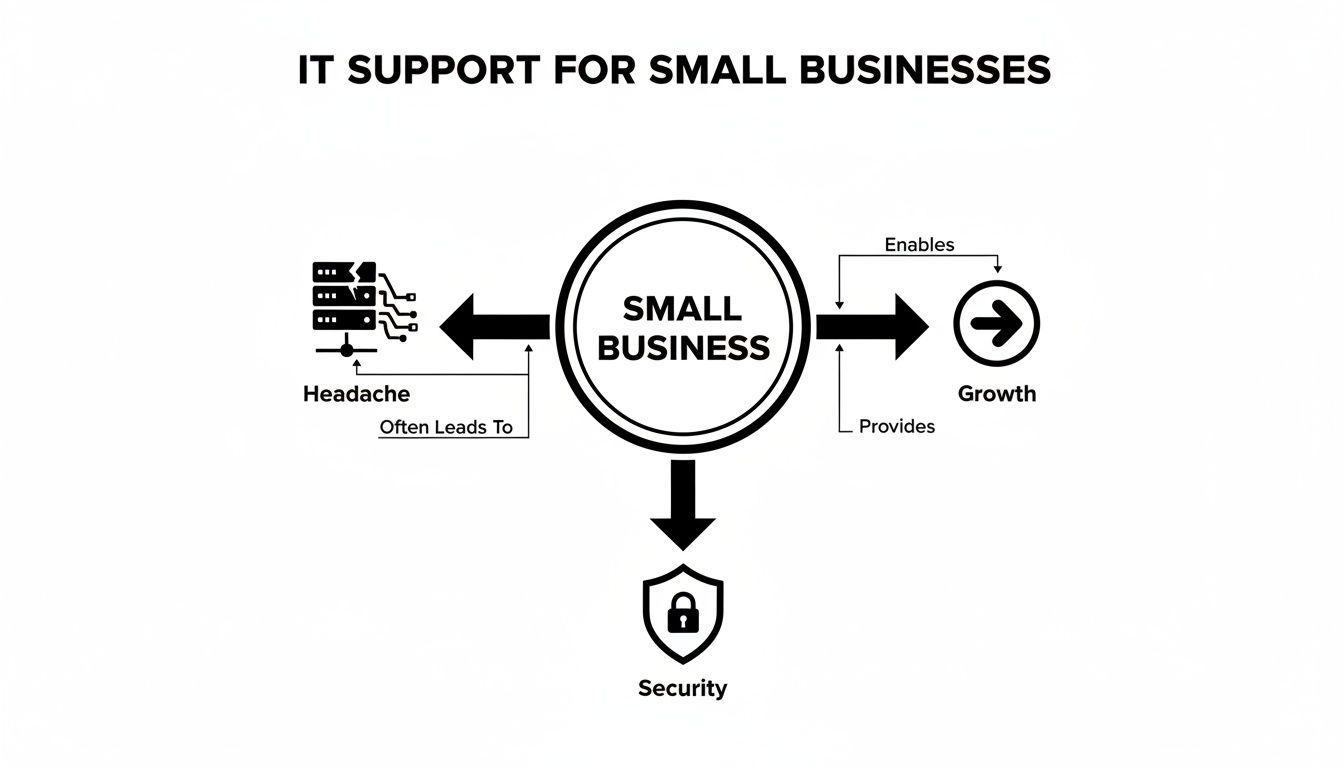
This really gets to the heart of it. We take the common tech frustrations that drain your time and resources and turn them into a powerful defense, giving you the peace of mind to focus on growth.
24/7 Proactive Monitoring and Maintenance
This is the most important service we provide, and ironically, it’s the one you’ll hopefully never notice. We act as a constant, silent guardian for your network, servers, and computers, using powerful tools to watch over their health and performance around the clock.
Practical Example: Let's say we get an alert that a server's hard drive is at 95% capacity. This is a ticking time bomb—once it hits 100%, applications will crash and data could be lost. Instead of you finding out when everything breaks, we see the alert, archive old files, clear temporary data, and resolve the issue after hours. Your team arrives the next morning with zero disruption.
Responsive Help Desk Support
When tech problems do pop up—and they always do—your team needs a fast, reliable expert to turn to. A dedicated help desk is your direct line to our team for any question, no matter how small.
Practical Example: Your marketing manager can't get a critical new design software to install correctly. Instead of wasting two hours searching online forums, they submit a help desk ticket. Our technician can remote into their computer, troubleshoot the installation error (which turns out to be a permissions issue), and have the software running in 15 minutes. The marketing manager gets back to designing the campaign, and you don't lose hours of productivity.
An effective help desk is a productivity multiplier. Studies show that employees can lose nearly 50 hours per year dealing with minor IT issues. We give that time back to your business, which goes straight to your bottom line.
This support is about more than just fixing broken things. It's also about empowerment. A team member at a Henderson law firm could call our help desk to learn a faster way to manage documents in Microsoft 365, saving them valuable minutes every single day.
Business Continuity and Disaster Recovery
Let’s ask the tough question: what would happen if a fire, flood, or a major ransomware attack hit your office tomorrow? A Business Continuity and Disaster Recovery (BCDR) plan is your answer. It's not just a simple data backup; it's a complete playbook for getting your entire business back on its feet, fast.
Practical Example: A construction company's server gets hit by a ransomware attack, encrypting all their project files and financial records. Because their MSP had a BCDR plan in place, they don't pay the ransom. Instead, the MSP activates the plan: they wipe the infected server, restore a clean backup from the previous night to a new virtual server in the cloud, and have the company's team logged in and working within three hours. What could have been a business-ending event becomes a minor disruption.
Bolstering Your Security and Ensuring Compliance
For a small business, a single cyberattack is more than just a bad day. It can be a full-blown crisis. The non-stop barrage of ransomware, data breaches, and phishing scams is enough to keep any owner up at night, especially without a dedicated security team on the payroll. This is where managed IT services for small businesses go from being a nice-to-have to your most critical defense.

Think of an MSP as your outsourced cybersecurity department. We bring enterprise-grade security tools and expertise to the table, all at a price that actually works for a small business budget. We don’t sit around waiting for threats; we build layers of defense to keep them from ever getting to you in the first place.
This isn't just our opinion; it's a massive shift we're seeing across the industry. Recent managed services market research shows cybersecurity is now the top priority for small businesses looking for IT help. In fact, 83% of clients are putting a bigger emphasis on it than ever before. With 51% of organizations turning to MSPs specifically because of rising cyber threats, it's clear that expert security management is no longer optional.
Your Dedicated Digital Bodyguards
A real security strategy is so much more than just installing antivirus software and hoping for the best. It's a coordinated defense protecting every possible way into your network. Your MSP acts like a team of digital bodyguards, with each person specializing in a different area of your protection.
Here’s a practical look at that defense:
- Endpoint Protection: This is advanced antivirus for every business device. Example: An employee accidentally clicks a malicious link in an email. Instead of infecting the entire network, the endpoint protection software on their laptop isolates and quarantines the threat instantly, sending an alert to the MSP for review.
- Firewall Management: Your firewall is the front gate to your digital castle. An MSP doesn't just set it up and walk away. We configure it, watch it 24/7, and constantly update it to block intruders and malicious traffic from getting inside.
- Security Awareness Training: Your team is your first line of defense. Actionable Insight: We provide simulated phishing tests. An email that looks like it's from UPS with a "tracking link" is sent to your staff. The MSP tracks who clicks it. Those who do are automatically enrolled in a short, 5-minute training video on how to spot fake emails. This practical, low-pressure training dramatically reduces real-world risk.
Navigating Complex Compliance Rules
For many businesses right here in Henderson, NC, security isn't just about keeping data safe—it’s about following strict industry regulations. If you're in finance, law, or property management, you're handling sensitive information protected by laws with some serious teeth.
Practical Example: A local financial advisory firm must comply with the Gramm-Leach-Bliley Act (GLBA). An MSP can help them by implementing and documenting specific controls, such as:
- Enforcing Multi-Factor Authentication (MFA) on all accounts accessing client data.
- Encrypting all laptops to protect data if a device is lost or stolen.
- Generating quarterly reports that show all security measures are active and audited, ready for any regulatory checks.
This turns complex legal requirements into a simple, manageable checklist. You can dive deeper into this by reading our guide on conquering compliance with an MSP. At the end of the day, having that expert guidance gives you true peace of mind.
Getting Your Head in the Cloud—And Why It's Not as Complicated as It Sounds
"The cloud." It's a term that gets thrown around a lot, often sounding overly technical and a bit mysterious. But for a small business, the benefits are anything but abstract. Think of it less as complex tech and more as a set of powerful tools that make your business more flexible, efficient, and—most importantly—resilient.
A great Managed Service Provider (MSP) is your guide, cutting through the jargon and making these solutions practical and easy to manage.

Let's forget the buzzwords and talk about what these services actually do. A "Microsoft 365 migration" is really just about giving your team the ability to work together securely from anywhere. "Cloud backups" is our way of making sure a fire, flood, or theft at your office doesn't wipe out your business by keeping a copy of your critical data stored safely somewhere else.
This isn't just a trend; it's the new standard for doing business. An incredible 94% of organizations are already using or planning to adopt cloud tools, and 71% of SMEs see them as absolutely critical for their future. The proof is in the numbers, and you can see more managed services statistics on Scoop.market.us.
Making Hybrid Work Actually Work
In a world where employees need flexibility, the cloud is the engine that makes a hybrid work model run smoothly. A good MSP sets up the systems that let your team operate just as effectively from their home office or the road as they do at their desk.
It's about so much more than just email. It's about unified communications that tie everyone together.
- VoIP Phone Systems: Practical Example: A Henderson real estate agent is showing a property. A client calls her office line, and it rings directly on her cell phone through a mobile app. She can then transfer the call to the agency's transaction coordinator back at the office with a single tap. The client has a seamless experience, and the agent never misses a call.
- Secure File Sharing: Actionable Insight: Instead of emailing sensitive client contracts, create a secure, shared folder in Microsoft SharePoint or OneDrive. You can grant specific clients temporary access to only their folder, where they can view and sign documents. Access is automatically revoked after the project is complete. This is far more secure than email attachments.
An MSP doesn't just hand you the keys to these tools; we integrate them and lock them down. When an employee leaves the company, we ensure their access to sensitive data is cut off instantly across every device, protecting your business.
Building a More Resilient Business
One of the biggest wins with the cloud is building a business that can take a punch. When you move your core operations into a secure cloud environment, you’re no longer vulnerable to a single point of failure at your physical location.
Practical Example: A small manufacturing plant runs its entire inventory and scheduling system on a server in the back office. A water pipe bursts over the weekend, flooding the office and destroying the server. Because they worked with an MSP to migrate their system to the cloud, the production manager can log in from home on his laptop, see the schedules, and coordinate with the team via their cell phones. Production continues with minimal delay while the office is repaired.
This isn't about ditching your office. It's about making your business operations independent of any one location. An MSP handles the entire migration, ensuring a smooth switch without interrupting your day-to-day. We cover this process in more detail in our cloud migration for small businesses guide.
How to Choose the Right MSP in Henderson NC
Picking a company to manage your IT isn't just about finding the cheapest quote. It’s about finding a real partner who gets your business and our local Henderson market. The right MSP will feel like part of your team, stopping problems before they start, while the wrong one can lead to constant frustration and expensive downtime.
To help you find the right fit here in Henderson, we put together a practical checklist. Forget the technical jargon—these are the business questions you need to ask to find a partner who will truly have your back.
Your Essential MSP Selection Checklist
When you're talking to potential IT providers, use these questions. They'll help you see past the sales pitch and understand what they can actually do for your business.
- Do you have proven experience with compliance in my industry?
Actionable Question: "Can you describe a specific project where you helped a local law office/financial firm/medical practice become compliant with [HIPAA/GLBA/etc.]? What were the exact steps you took?" Vague answers are a red flag. - Can you provide testimonials or references from local businesses similar to mine?
Actionable Question: "Could I speak with one of your current clients in the Henderson area who has about 10-20 employees? I'd like to ask them about your response times." - Is your support team local for fast on-site response?
Actionable Question: "If our main server goes down and we can't get online, what is your guaranteed on-site response time to our Henderson office? Is that time in your contract?" - How do you explain your Service Level Agreement (SLA)?
An SLA is their written promise to you. Ask them to walk you through it. Actionable Insight: Look for specific numbers. "A guaranteed 1-hour response time for critical issues" is a real promise. "We respond quickly" is a marketing slogan.
Don’t settle for vague answers. An SLA should provide you with complete peace of mind, outlining exactly what happens when you need help the most. It transforms their service from a casual promise into a binding commitment.
Local Expertise in Action
Choosing an MSP with deep roots in the Henderson community means you're getting a partner who's invested in seeing you succeed. They get the challenges and opportunities unique to our area, from seasonal business rushes to the specific needs of our manufacturing and professional services sectors.
Case Study: Henderson Manufacturing Firm Boosts Productivity
A local manufacturing firm was getting bogged down by its outdated systems. Their network was painfully slow, causing production delays, and they had no real plan for a disaster like a ransomware attack. They decided to partner with a local MSP who understood that for them, uptime was everything.
The MSP came in and did a full assessment, quickly spotting major security gaps and network bottlenecks. They put a proactive monitoring system in place, upgraded the firewall, and moved the company's critical production data to a hybrid cloud solution.
The results were immediate. Network speeds shot up, which put an end to the frustrating delays on the factory floor. With a solid backup and disaster recovery plan in place, the owners could finally sleep at night, knowing a single cyberattack wouldn't shut down their operations. The firm's productivity jumped by over 15% within six months—a direct result of choosing a partner who understood their specific industry.
Understanding Pricing and Service Agreements
Alright, let's get straight to the question every business owner asks: "What's this going to cost me?"
When looking at managed IT services, the price tag matters, but what you get for that price is what truly counts. The last thing you want are confusing contracts and surprise invoices that turn a good partnership sour.
Our goal is always to provide a predictable, all-inclusive cost. This turns your IT from a fluctuating, reactive expense into a stable, strategic part of your budget. Here’s a look at how pricing works and the single most important document in your IT partnership—the Service Level Agreement (SLA).
Decoding Common MSP Pricing Models
Most Managed Service Providers (MSPs) use one of a few common pricing models. There’s no single "best" one; the right fit depends on how your business is structured and how your team uses technology. It's about finding the model that delivers the most value for your specific situation.
Here’s a simple breakdown of what you'll see:
- Per-User Model: You pay a flat monthly fee for each employee on your team. This is perfect for businesses where people use multiple devices, like a laptop, desktop, and a smartphone.
- Practical Example: A law firm with 15 employees pays a set rate of $150/user, for a total of $2,250 per month. This covers all 15 staff members regardless of how many devices they use. When they hire a new paralegal, they know the IT cost will increase by exactly $150.
- Per-Device Model: With this model, you pay a set fee for each piece of hardware we manage—every server, workstation, printer, or firewall. This can be a great fit if you have more employees than devices, like in a manufacturing plant with shared computer kiosks.
- All-Inclusive Flat-Fee Model: This is the most comprehensive and straightforward option. You pay one predictable monthly price for a complete suite of services and unlimited support. That includes proactive monitoring, security, help desk calls, and strategic planning. No more surprise bills for after-hours emergencies.
A transparent, all-inclusive model is often the best value for a small business. It perfectly aligns our goals with yours. We're incentivized to keep your systems running flawlessly to minimize our own support time, which directly benefits you with less downtime and more productivity.
Why Your Service Level Agreement Is So Important
Think of the Service Level Agreement (SLA) as the official blueprint for our partnership. It’s much more than just a contract. This is where we put our promises in writing, clearly defining everything from guaranteed response times to how we'll handle a critical system failure.
Actionable Insight: When reviewing an SLA, grab a highlighter and mark the specific, measurable promises. Look for phrases like:
- "Critical issue response time: Under 20 minutes"
- "Server uptime guarantee: 99.9%"
- "On-site support dispatch: Within 4 business hours"
- "Backup verification: Daily, with weekly test restores"
If you can't find hard numbers like these, ask for them to be added. A good partner will be happy to commit to their service levels in writing.
Frequently Asked Questions About Managed IT
Stepping into the world of managed IT can bring up a lot of questions. We get it. Here are the answers to some of the most common things we hear from small business owners who are considering partnering with a Managed Service Provider (MSP).
Is My Business Too Small for Managed IT Services?
Not at all. In fact, we find that small and mid-sized businesses often see the biggest and fastest return from working with an MSP. You get the expertise of an entire IT department—from cybersecurity specialists to network pros—for a predictable fee that’s usually a lot less than the salary of a single full-time IT person.
Practical Example: A 10-person business can't afford a $75,000/year IT manager. But for a fraction of that cost, they can partner with an MSP and get a whole team of experts on-call. This levels the playing field, giving them access to the same high-end security and support as their larger competitors.
What Is the Difference Between Managed IT and Break-Fix Support?
The biggest difference is the entire mindset. A "break-fix" company is like a repairman you only call when something is broken. They make money when your technology fails, so their business model literally depends on you having problems.
A Managed Service Provider (MSP) like us works on a proactive partnership model. Our flat monthly fee means our success is tied directly to keeping your systems running smoothly and securely. Practical Example: Under break-fix, a server crash might cost you $1,500 in emergency repair fees. With an MSP, that same server is monitored 24/7. We would replace a failing component before it crashes, as part of your monthly fee, saving you both the money and the downtime.
Will I Lose Control Over My IT if I Hire an MSP?
You actually gain more strategic control, not less. Think about it: by handing off the daily technical firefighting—like software updates, user lockouts, and troubleshooting—you and your leadership team are freed up to focus on the bigger picture.
Actionable Insight: A good MSP provides a quarterly business review. In this meeting, we don't just talk about technical details. We show you how technology is supporting your business goals. For example: "You wanted to improve remote team collaboration. This quarter, we saw a 40% increase in the use of the shared document system we implemented, and help desk tickets related to remote access dropped by 60%." This gives you high-level control over strategy, not low-level control over problems.
How Long Does It Take to Switch to a Managed Service Provider?
We plan the entire onboarding process to be as smooth and non-disruptive as possible. Any professional MSP will start with a thorough assessment of your current IT setup to understand every piece of your network, software, and hardware.
From there, we create a detailed migration plan designed to have minimal impact on your team's day-to-day work. The whole process can take anywhere from a few days to a couple of weeks depending on how complex your environment is, but our number one goal is always a seamless, zero-downtime transition for your business.
Ready to take the next step and see how a dedicated IT partner can help your business thrive? Cyberplex Technologies LLC provides proactive IT support and security tailored for small businesses in the Henderson area. Contact us today for a no-obligation consultation.